

Security by Design: Integrating Security into Digital Design
What is Security by Design?
Security by Design is a cybersecurity approach that involves integrating security from the earliest stages of designing systems, applications, and digital infrastructures.
In practical terms, this means developing technological solutions in which security is not an add-on introduced later, but a structural element.
Every component – from software to infrastructure architectures – is designed with potential risks in mind, with the aim of minimizing vulnerabilities even before the system goes into operation.
How does Security by Design work?
Security by Design makes it possible to move beyond a purely reactive logic, based on intervention after incidents or breaches, and to build more robust and resilient digital environments. Designing, for example, a secure authentication system from the outset – with structured identity management, access controls, and credential protection – avoids complex corrective actions once the application is already in use.
In infrastructure contexts, such as gas networks, designing “secure from the start” also means ensuring that components such as smart meters, IoT sensors, or remote control systems adopt encrypted protocols, reliable authentication mechanisms, and robust access models. Without these measures introduced at the design stage, the entire technology chain could be exposed to operational risks.
Today, Security by Design underpins the main secure development frameworks and DevSecOps (Development, Security, Operations) practices adopted internationally, and represents a key element in ensuring the protection of data, processes, and critical services.
Difference between reactive security and integrated security
The difference between a reactive approach and Security by Design does not concern only the point at which action is taken, but also the overall impact on the quality and sustainability of digital systems.
In the traditional model, security is addressed after development, often following an incident or the discovery of a vulnerability. By contrast, Security by Design integrates security from the initial stages, accompanying the entire life cycle of the system.
| Aspect | Reactive Security | Integrated Security (Security by Design) |
| Timing of intervention | Acts after an incident occurs or a vulnerability is discovered | Integrates security controls from the design phase |
| Approach | Based on patches and corrective updates | Reduces the likelihood of vulnerabilities reaching production |
| Costs | Involves high and often unplanned costs | Enables more predictable cost management |
| Impact on systems | May require structural changes to systems already in operation | Limits the need for invasive corrective actions |
| Operational continuity | May cause operational disruptions and impact services | Improves reliability, operational continuity, and overall quality |
In short, while reactive security intervenes to “correct,” integrated security aims to “prevent,” with clear benefits in terms of efficiency, resilience, and sustainability.
Why has Security by Design become crucial?
In recent years, the digital attack surface has grown exponentially, making a security approach based on post-development interventions increasingly ineffective.
The growing digitalization of processes, together with the evolution of IT architectures, has increased the complexity of information systems. Distributed applications, cloud services, and integration across different platforms make digital ecosystems ever more interconnected and dynamic.
In this scenario, even a single vulnerability can spread rapidly across connected systems. Security by Design therefore represents a more effective model for addressing the challenges of modern cybersecurity, especially in sectors managing sensitive data, essential services, and critical infrastructures.
Increasing complexity of digital systems
The complexity of digital systems translates into greater difficulty in controlling and managing attack surfaces.
Consider, for example, an application that uses cloud services, external APIs, and distributed microservices: every point of interconnection represents a potential risk vector.
In the gas distribution sector, this complexity is amplified by the growing adoption of:
• IoT sensors along the network, monitoring pressure, flows, and possible anomalies;
• smart meters, which communicate metering data to central systems;
• SCADA systems, used for the real-time control of critical infrastructures;
• APIs used by field operators to synchronize maintenance activities and network interventions.
Without a structured security approach, a single misconfigured component – for example, a sensor with default credentials – can become an entry point for malicious activity. Integrating security from the design stage makes it possible to govern this complexity, define consistent controls, and reduce risks along the entire technology chain.
Impact of vulnerabilities on companies and critical infrastructures
Unmanaged vulnerabilities can have significant consequences from operational, economic, and reputational perspectives.
In the energy sector and in gas network management, a malfunction or unauthorized access can affect service continuity and infrastructure safety.
For example:
• an inadequately protected SCADA interface could allow the manipulation of operational parameters such as pressure or valve activation;
• APIs exposing operational data without granular controls may reveal sensitive information on infrastructure assets;
• unencrypted communications between smart meters and central systems may be intercepted or altered.
Integrating security already at the design stage helps prevent these scenarios, reducing both risk and the costs associated with potential incidents.
How does a Security by Design approach emerge?
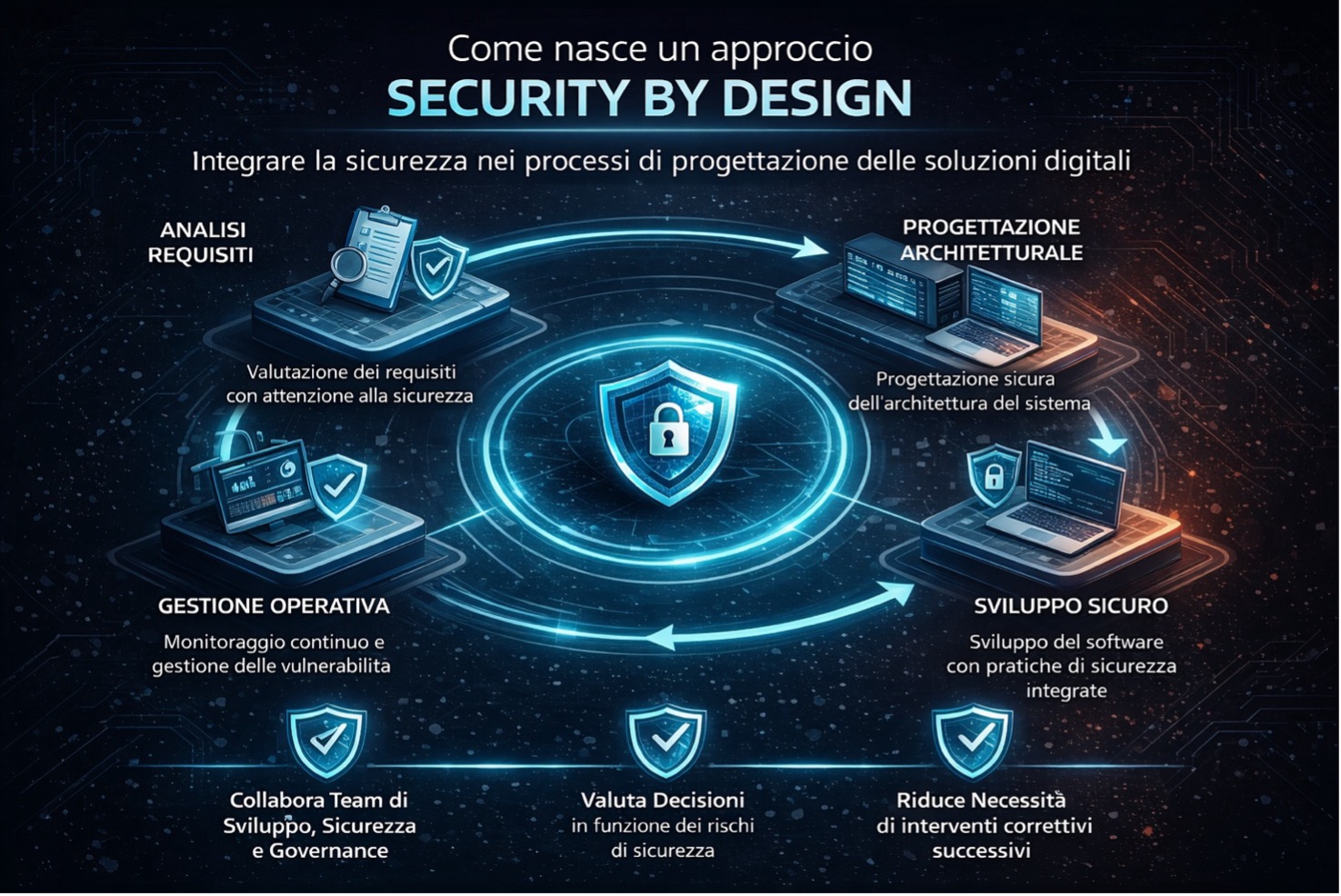
A Security by Design approach emerges from the systematic integration of security into the processes that accompany the entire life cycle of digital solutions.
Security is introduced as early as the requirements analysis phase, continues through architectural design, and extends into development and operational management. In practice, every design decision – from the choice of technologies to data management – is also assessed in light of security risks.
This model requires close collaboration between development, security, and governance teams, which must work in a coordinated way. The goal is to ensure solutions that are coherent, effective, and sustainable over time, reducing the need for subsequent corrective actions.
Examples of problems caused by the absence of Security by Design
When security is not taken into account from the earliest stages, critical issues emerge that can compromise system functionality.
Among the most frequent:
• insecure default configurations;
• inadequate credential management;
• lack of encryption for sensitive data;
• exposure of APIs without adequate access controls;
• absence of logging and monitoring systems.
In the context of gas networks:
• an IoT sensor deployed in the field with unvalidated firmware may be compromised and used to gain lateral access to other systems;
• a smart meter without end-to-end encryption may expose consumption data or be manipulated;
• an unprotected firmware update pipeline may allow unauthorized code to be injected into thousands of operational devices.
Integrating security from the outset makes it possible to avoid these critical issues, making systems more reliable and easier to manage over time.
How to adopt Security by Design
Adopting Security by Design requires change involving technologies, processes, and organizational culture.
It is not just about introducing security tools, but about integrating protection as a structural element into decision-making and operational processes. This implies defining clear requirements, precise responsibilities, and shared working methods across the different teams involved.
Best practices and preventive security controls
Adopting Security by Design translates into operational practices that support all phases of the system life cycle.
The main ones include:
• Risk analysis already at the design stage: preventive identification of threats and vulnerabilities in order to guide design choices from the outset.
• Design of secure architectures with system segmentation: definition of isolated and compartmentalized systems to limit the propagation of possible attacks.
• Application of the least privilege principle: assigning users and systems only the permissions strictly necessary to perform their functions.
• Structured identity and access management (IAM): centralized control of digital identities and access rights to resources.
• Code review and security testing during development: continuous verification of software in order to identify and correct vulnerabilities before production release.
• Integration of security into DevOps processes (DevSecOps): inclusion of automated controls in development pipelines to continuously monitor and prevent risks.
These practices are progressively integrated throughout the development life cycle rather than treated as isolated activities. For example, introducing automated controls into development pipelines makes it possible to identify vulnerabilities in the early stages, preventing them from reaching production.
Testing, monitoring, and continuous improvement
Security by Design does not end at the design stage, but requires continuous activity throughout the entire life cycle of systems.
Periodic testing, vulnerability monitoring, and configuration updates make it possible to maintain high levels of protection over time. In a context where cyber threats evolve rapidly, the ability to adapt becomes a central element.
In this sense, Security by Design is not just a technical approach, but a strategic lever for ensuring the resilience of digital infrastructures and the continuity of services in increasingly complex environments.